Song: On a Golden Springtime (CS. 88)
Thought: The Great Apostasy was a time of spiritual darkness, but we now live in a time when we can partake of “the light of the glorious gospel of Christ” (2 Corinthians 4:4; see also D&C 45:28). The fulness of the gospel has been restored, and the true Church of Jesus Christ is on the earth again. No other organization can compare to it. It is not the result of a reformation, with well-meaning men and women doing all in their power to bring about change. It is a restoration of the Church established by Jesus Christ. It is the work of Heavenly Father and His Beloved Son. (True to the Faith)
Object Lesson: Show your family some old pennies that are tarnished and no longer shiny and new as they once were. Discuss with your family why the pennies are not the same as they were and what they have lost. Then compare those old pennies to the gospel. How when Christ was on the earth the gospel he taught was pure and correct. Over time it got changed by the world and lost the proper authority (or shine). Then place the pennies in lemon juice or vinegar and let your family take a small brush and scrub the pennies to see if they can become clean again. Compare this to a restoration of the gospel through Joseph Smith. Discuss how the proper authority and true gospel principles have been restored through him. (Idea adapted from here.)
Video: What the Restoration Means to Me
Lesson Activity:
Discuss with your younger family members what a testimony is and what we say when we are bearing our testimonies. Prepare something beforehand that could represent a podium with a microphone and encourage them to be prepared to practice bearing their testimonies of the restoration of the gospel.
As a family read together the first six paragraphs of Dallin H. Oaks’s article “The Only True and Living Church.” Ask your family how we can testify of the only true Church in a way that avoids offending others. Divide the remaining sections of the talk among them, and ask them to read their sections and look for what Elder Oaks does to powerfully testify of the restored gospel while being respectful to the beliefs of others. Invite your family to take turns bearing their testimonies to each other about the restoration of the gospel.
This Week's Challenge: Encourage your family members to find ways to bear their testimonies of the restored gospel with their friends and associates this week. As an added challenge encourage them to be prepared to bear their testimonies in your next fast and testimony sacrament meeting.
4.08.2013

3.31.2013
Week 13: The First Vision
Song: Joseph Smith's First Prayer (H. 26)
Thought:
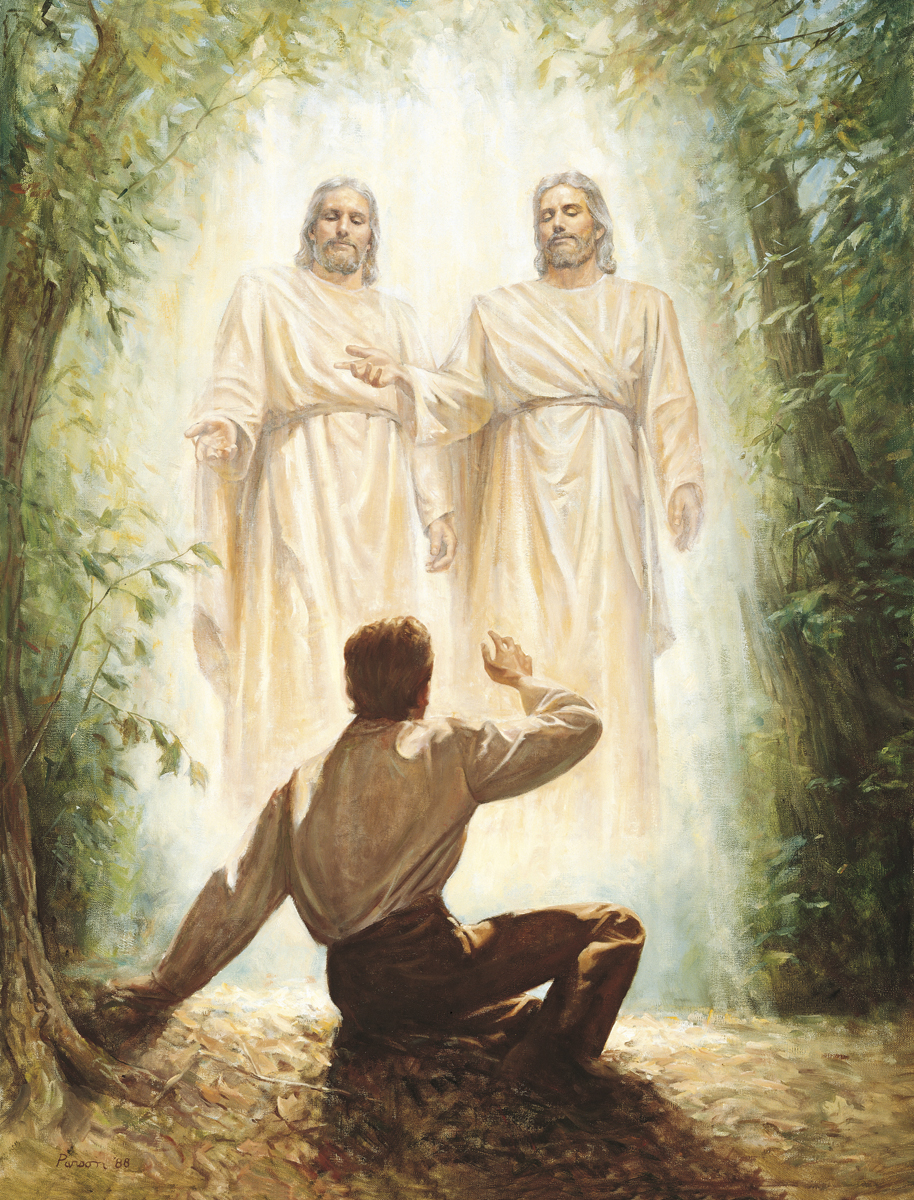
In the spring of 1820, 14-year-old Joseph Smith was searching for the true Church of Jesus Christ when he read a passage in the Bible: “If any of you lack wisdom, let him ask of God, that giveth to all men liberally, and upbraideth not; and it shall be given him” ( James 1:5; see also Joseph Smith—History 1:11–12). With simple, unwavering faith, young Joseph followed the counsel in that passage. He went alone to a grove of trees, where he prayed to know which church he should join. In answer to his prayer, God the Father and
Jesus Christ appeared to him. Among other things, They told him that he should join none of the churches then in existence. (See Joseph Smith—History 1:13–20.) (Taken from True to the Faith: Joseph Smith)
Object Lesson:
(Ahead of time: Take two cans of food that are similar in size, but contain different foods. Remove the labels.) Show your family the two cans and discuss how from the outside they look the same. The only difference between them is possibly what is on the inside. Compare these two cans to the many different churches found on the earth. Explain that from the outside they may seem the same, but the difference is on the inside. Joseph Smith had questions about the many different churches on the earth in his day and wanted to know which church he should join. He decided to pray to Heavenly Father to find out for himself. What happened when he prayed we now refer to as the First Vision. (Idea adapted from here.)
Video: The Restoration
(This video in full is almost 30 minutes long. I would not necessarily recommend watching the entire video in today's lesson. Consider previewing the video and cuing it up so that the focus of it is on The First Vision.)
Lesson Activity:

Consider the following activity from the Come, Follow Me curriculum for members of your family able to participate:
Invite them to write down some of the blessings they have received because of the First Vision. Ask them to look for other blessings of the First Vision as they read the last 10 paragraphs of President Dieter F. Uchtdorf’s talk “The Fruits of the First Vision.” Invite them to share what they find and their feelings about the importance of the First Vision.
This Week's Challenge: Challenge each of your family members to find time this week to go off to a quiet place and pray out loud to their Heavenly Father to find out for themselves about the First Vision. If there are members of your family who have already received a witness of the First Vision, challenge them to pray for an opportunity to share their testimony of it with someone else.
Thought:
In the spring of 1820, 14-year-old Joseph Smith was searching for the true Church of Jesus Christ when he read a passage in the Bible: “If any of you lack wisdom, let him ask of God, that giveth to all men liberally, and upbraideth not; and it shall be given him” ( James 1:5; see also Joseph Smith—History 1:11–12). With simple, unwavering faith, young Joseph followed the counsel in that passage. He went alone to a grove of trees, where he prayed to know which church he should join. In answer to his prayer, God the Father and
Jesus Christ appeared to him. Among other things, They told him that he should join none of the churches then in existence. (See Joseph Smith—History 1:13–20.) (Taken from True to the Faith: Joseph Smith)
Object Lesson:
(Ahead of time: Take two cans of food that are similar in size, but contain different foods. Remove the labels.) Show your family the two cans and discuss how from the outside they look the same. The only difference between them is possibly what is on the inside. Compare these two cans to the many different churches found on the earth. Explain that from the outside they may seem the same, but the difference is on the inside. Joseph Smith had questions about the many different churches on the earth in his day and wanted to know which church he should join. He decided to pray to Heavenly Father to find out for himself. What happened when he prayed we now refer to as the First Vision. (Idea adapted from here.)
Video: The Restoration
(This video in full is almost 30 minutes long. I would not necessarily recommend watching the entire video in today's lesson. Consider previewing the video and cuing it up so that the focus of it is on The First Vision.)
Lesson Activity:
Here is a coloring page that younger members of your family may enjoy coloring!
Consider the following activity from the Come, Follow Me curriculum for members of your family able to participate:
Invite them to write down some of the blessings they have received because of the First Vision. Ask them to look for other blessings of the First Vision as they read the last 10 paragraphs of President Dieter F. Uchtdorf’s talk “The Fruits of the First Vision.” Invite them to share what they find and their feelings about the importance of the First Vision.
This Week's Challenge: Challenge each of your family members to find time this week to go off to a quiet place and pray out loud to their Heavenly Father to find out for themselves about the First Vision. If there are members of your family who have already received a witness of the First Vision, challenge them to pray for an opportunity to share their testimony of it with someone else.
The Restoration
This is a longer video, but it is a wonderful overview of the restoration of Christ's church in these latter days.
3.23.2013
Week 12: Forgiveness
Song: Help Me, Dear Father (CS. 99)
Thought: The great Atonement was the supreme act of forgiveness. The magnitude of that Atonement is beyond our ability to completely understand. I know only that it happened, and that it was for me and for you. The suffering was so great, the agony so intense, that none of us can comprehend it when the Savior offered Himself as a ransom for the sins of all mankind.
It is through Him that we gain forgiveness. It is through Him that there comes the certain promise that all mankind will be granted the blessings of salvation, with resurrection from the dead. It is through Him and His great overarching sacrifice that we are offered the opportunity through obedience of exaltation and eternal life. (Forgiveness by Gordon B. Hinckley)
Object Lesson:
Prepare a simple obstacle course. Have each person try to get through it backwards. After everyone has had a turn, let them go through the same course looking forward. Discuss how looking forward is like forgiveness, because when we forgive, we can concentrate on our future and forget the hurts of our past. (Found here)
Video: Forgiveness: My Burden Was Made Light
Lesson Activity:
For young children tell the story of Joseph who was sold into Egypt as a slave by his brothers. Explain that when he was older he had a chance to get back at them, but instead forgave them and even helped them to survive a famine. Let them color this picture.

Read together with the older members of your family, the parable of the unmerciful servant in Matthew 18:23–35, and help your family calculate and compare the debts of the servant and his fellow servant (see “Weights and Measures” in the Bible Dictionary). What does your family learn from this parable about forgiveness? (Come, Follow Me: Why do I need to forgive others?)
This Week's Challenge: Challenge your family to focus this week on offering true forgiveness to those who may have hurt or offended them. As an added challenge encourage them to accept the forgiveness others seek from them. If someone says "I'm sorry...." respond with "I accept your apology" rather than "that's okay" or "don't worry about it." Remind your family that it is okay to acknowledge that what has been said or done cause pain, but that it is important to let go of that pain--even if no one ever apologizes!
Thought: The great Atonement was the supreme act of forgiveness. The magnitude of that Atonement is beyond our ability to completely understand. I know only that it happened, and that it was for me and for you. The suffering was so great, the agony so intense, that none of us can comprehend it when the Savior offered Himself as a ransom for the sins of all mankind.
It is through Him that we gain forgiveness. It is through Him that there comes the certain promise that all mankind will be granted the blessings of salvation, with resurrection from the dead. It is through Him and His great overarching sacrifice that we are offered the opportunity through obedience of exaltation and eternal life. (Forgiveness by Gordon B. Hinckley)
Object Lesson:
Prepare a simple obstacle course. Have each person try to get through it backwards. After everyone has had a turn, let them go through the same course looking forward. Discuss how looking forward is like forgiveness, because when we forgive, we can concentrate on our future and forget the hurts of our past. (Found here)
Video: Forgiveness: My Burden Was Made Light
Lesson Activity:
For young children tell the story of Joseph who was sold into Egypt as a slave by his brothers. Explain that when he was older he had a chance to get back at them, but instead forgave them and even helped them to survive a famine. Let them color this picture.
Read together with the older members of your family, the parable of the unmerciful servant in Matthew 18:23–35, and help your family calculate and compare the debts of the servant and his fellow servant (see “Weights and Measures” in the Bible Dictionary). What does your family learn from this parable about forgiveness? (Come, Follow Me: Why do I need to forgive others?)
This Week's Challenge: Challenge your family to focus this week on offering true forgiveness to those who may have hurt or offended them. As an added challenge encourage them to accept the forgiveness others seek from them. If someone says "I'm sorry...." respond with "I accept your apology" rather than "that's okay" or "don't worry about it." Remind your family that it is okay to acknowledge that what has been said or done cause pain, but that it is important to let go of that pain--even if no one ever apologizes!
Forgiveness: My Burden Was Made Light
This video shares one families experience with tragedy and how the power of forgiveness has blessed their lives.
3.16.2013
Week 11: Repentance
Song: Repentance (CS. 98)

Thought: The invitation to repent is rarely a voice of chastisement but rather a loving appeal to turn around and to “re-turn” toward God. It is the beckoning of a loving Father and His Only Begotten Son to be more than we are, to reach up to a higher way of life, to change, and to feel the happiness of keeping the commandments. Being disciples of Christ, we rejoice in the blessing of repenting and the joy of being forgiven. They become part of us, shaping the way we think and feel. (“Repent … That I May Heal You”
Neil L. Andersen)
Object Lesson: Consider using the following example from Repentance: Making the Inside Clean
By Michael Weir Allred. Either describe this scenario to your family or have a bucket with water in it, a brick, and additional water to refill the bucket.
Picture in your mind a bucket of water. That bucket represents you and me, and the water represents the Spirit, which can reside within us. The water can also represent our pure, worthy state.
Now imagine that you have a brick and have dropped it into the bucket. That brick is like sin—it’s hard and rough and impure. As soon as it enters the bucket, it causes some of the water to slosh out. When we sin, we displace some of the good things in our life, like our peace of mind and some of our capacity to feel the Spirit.
Repenting is like taking that brick out of the bucket of water and making the water pure and clean again. But the repentance isn’t complete by just removing the brick, because the bucket is still not full. We must add more water to fill the bucket again.
When we repent, it is not enough just to forsake sin; we must replace the empty space left by sin by living righteously. We need to refill our spiritual bucket by doing those things that invite the Spirit back into our lives. We need to recommit to living an obedient life, to forgiving others, to restoring damages, and to enduring faithfully to the end.
Video: Rescued by Christ
As you watch this video together ask your family to consider how this man's life could have turned out differently had he not chosen to make Christ his best friend. Following the video discuss ways that we can reach out to others who are going through the repentance process or who have repented of past mistakes. Remind your family that the worth of souls is great and that there is joy to be found in each person who repents.
Lesson Activity:
For the younger members of your family consider using one of the following activities from the Primary 3 Lesson Manual:
1. Prepare the following sheet for each child. Have the children write the four steps used in repentance. For younger children, draw circles for the two faces and have the children draw the faces in the circles themselves. Suggest that the children place this paper in their homes where they can easily see it to remind them how to repent and change their sad feelings to happy feelings.

2. Have the children act out feeling sorry and asking someone for forgiveness for some wrong they have done. Emphasize that sincerity is important when asking for forgiveness. This sincerity often shows in their tone of voice. Demonstrate for them how to ask for forgiveness both insincerely and sincerely, and have them practice asking with the right tone of voice and posture.
For the older members of your family consider using the following activity from the Come, Follow Me lesson for YW. Assign each family member to read one of the five aspects of repentance that Elder D. Todd Christofferson identifies in his talk “The Divine Gift of Repentance.” What do they learn from this talk about how we can know if we have truly repented? What else do they learn about repentance from Elder Christofferson’s message?
This week's challenge: Encourage your family to continue last week's challenge to be worthy to partake of the sacrament by fully repenting. Work together as a family to utilize the 4 steps of repentance in our family relationships each day.
Thought: The invitation to repent is rarely a voice of chastisement but rather a loving appeal to turn around and to “re-turn” toward God. It is the beckoning of a loving Father and His Only Begotten Son to be more than we are, to reach up to a higher way of life, to change, and to feel the happiness of keeping the commandments. Being disciples of Christ, we rejoice in the blessing of repenting and the joy of being forgiven. They become part of us, shaping the way we think and feel. (“Repent … That I May Heal You”
Neil L. Andersen)
Object Lesson: Consider using the following example from Repentance: Making the Inside Clean
By Michael Weir Allred. Either describe this scenario to your family or have a bucket with water in it, a brick, and additional water to refill the bucket.
Picture in your mind a bucket of water. That bucket represents you and me, and the water represents the Spirit, which can reside within us. The water can also represent our pure, worthy state.
Now imagine that you have a brick and have dropped it into the bucket. That brick is like sin—it’s hard and rough and impure. As soon as it enters the bucket, it causes some of the water to slosh out. When we sin, we displace some of the good things in our life, like our peace of mind and some of our capacity to feel the Spirit.
Repenting is like taking that brick out of the bucket of water and making the water pure and clean again. But the repentance isn’t complete by just removing the brick, because the bucket is still not full. We must add more water to fill the bucket again.
When we repent, it is not enough just to forsake sin; we must replace the empty space left by sin by living righteously. We need to refill our spiritual bucket by doing those things that invite the Spirit back into our lives. We need to recommit to living an obedient life, to forgiving others, to restoring damages, and to enduring faithfully to the end.
Video: Rescued by Christ
As you watch this video together ask your family to consider how this man's life could have turned out differently had he not chosen to make Christ his best friend. Following the video discuss ways that we can reach out to others who are going through the repentance process or who have repented of past mistakes. Remind your family that the worth of souls is great and that there is joy to be found in each person who repents.
Lesson Activity:
For the younger members of your family consider using one of the following activities from the Primary 3 Lesson Manual:
1. Prepare the following sheet for each child. Have the children write the four steps used in repentance. For younger children, draw circles for the two faces and have the children draw the faces in the circles themselves. Suggest that the children place this paper in their homes where they can easily see it to remind them how to repent and change their sad feelings to happy feelings.
(The four steps are: Feel sorry, Ask forgiveness, Right the wrong, Don’t repeat the wrong)
For the older members of your family consider using the following activity from the Come, Follow Me lesson for YW. Assign each family member to read one of the five aspects of repentance that Elder D. Todd Christofferson identifies in his talk “The Divine Gift of Repentance.” What do they learn from this talk about how we can know if we have truly repented? What else do they learn about repentance from Elder Christofferson’s message?
This week's challenge: Encourage your family to continue last week's challenge to be worthy to partake of the sacrament by fully repenting. Work together as a family to utilize the 4 steps of repentance in our family relationships each day.
Subscribe to:
Posts (Atom)